If you grew up when I did, castor oil probably came with a shudder. In my house, it was the dreaded spoonful somebody swore would “clean you out,” and for years I assumed that was simply what castor oil was for. But over time, and after plenty of trial, error, and stained pillowcases, I learned that most folks are using it the wrong way entirely. It has its place, but only when you respect what it is: a very thick plant oil with a few practical uses and some very real safety limits.
So if you’ve got a bottle tucked in the bathroom cabinet, here’s the right way to use it. I’m going point by point through the mistakes I see most often, including the hard no’s, the one honest exception where there is one, and the exact amounts, timing, and common-sense cautions I wish somebody had explained to me years ago.
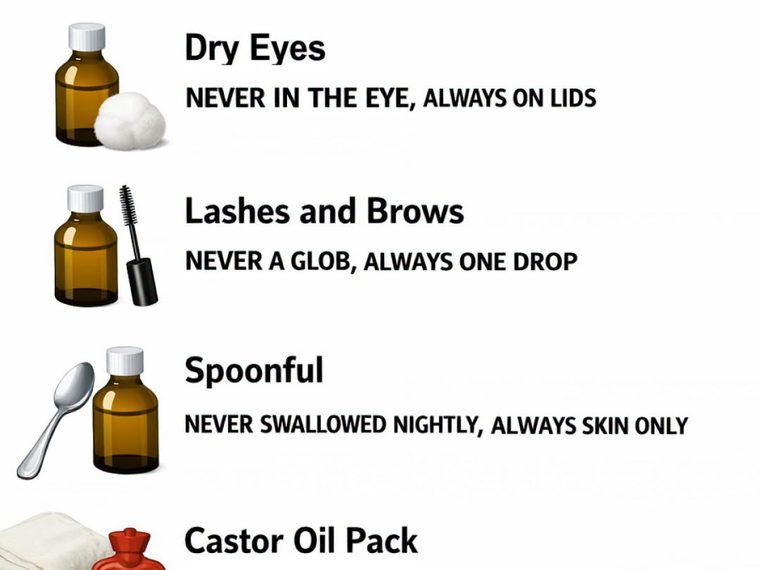
1. For dry eyes, never put plain castor oil in the eye, always use it on the lids
This is one of the biggest misunderstandings. Plain bottled castor oil is not sterile, and the eye is too delicate for that gamble. Putting drops straight into the eye can blur your vision, sting, and irritate the surface. The safer at-home way is external only: wash your hands, place 1 small drop on a clean fingertip or cotton swab, and smooth it along the closed upper and lower lids at bedtime, no more than once nightly. Keep it on the skin, not in the eye.
There is one honest exception: pharmacy-made eye drops that contain castor oil and are specifically labeled for eye use. Those are sterile and formulated for the eye itself. But a regular bottle from your cabinet is not the same thing, and I would not treat it like one.
2. For lashes and brows, never use a thick glob, always use one drop total
I know the temptation is to slather it on and hope for better lashes by morning, but that is where trouble starts. Too much oil migrates into the eyes while you sleep and can also sit heavy around the follicles, trapping debris and clogging pores. One drop total is plenty for both brows, or one drop total for both lash lines, 2 to 4 nights a week. I like to put that single drop on a clean spoolie or cotton swab and brush off the excess before applying.
The exception is simply this: if one drop feels like too much, use less, not more. A barely coated brush is enough. The goal is a light film, not a shiny layer that can run.
3. Never take castor oil nightly by mouth; use it on skin only
I’m going to be plain here because this old remedy has hung on far too long. Castor oil by mouth is a harsh stimulant laxative. It can cause cramping, urgent diarrhea, nausea, and dehydration, especially in older adults who do not bounce back from fluid loss as easily. That means it is not something to take nightly, “for regularity,” or just because you feel sluggish. For routine home use, keep it on the skin only.
There is one honest exception: a clinician may tell someone to take an oral castor oil product for a very specific short-term reason, following the package or medical directions exactly. Outside that, I would not use it as a home habit. And in pregnancy, avoid it entirely by mouth, because it can trigger contractions. That caution deserves to be said plainly.
4. For a castor oil pack, never leave it on overnight, always stop at 45 minutes maximum
This is another place where “more” is not better. A castor oil pack should not be an all-night affair. Long heat exposure can irritate skin, and if you’re using a heating pad or hot water bottle, there is a real burn risk, especially if you doze off. Keep sessions to 20 to 45 minutes, 2 to 4 times a week at most, and use gentle warmth rather than high heat.
The exception is a room-temperature pack with no heat, but even then I would still cap it at about 45 minutes. Once skin gets slick, occluded, and warm for too long, irritation becomes much more likely than benefit.
5. For cracked heels, rub it in well and then cover with cotton socks overnight
This is one of the most practical uses I’ve found. After washing and drying your feet thoroughly, rub about 1/4 to 1/2 teaspoon into each heel for a full 30 to 60 seconds. Really work it into the dry areas, then pull on clean cotton socks and leave them on overnight. Do this 3 to 5 nights a week. The socks matter because they hold the oil where you want it and keep you from greasing up the sheets.
The exception is if the heel is split open, bleeding, or has raw broken skin. In that case, do not apply castor oil there at all. Wait until the skin surface is closed again, because oil over damaged skin can sting and further irritate the area.
6. Choose cold-pressed, hexane-free castor oil
If you’re buying a bottle for skin use, the label matters. I look for cold-pressed and hexane-free because that tells me the oil was extracted with less harsh processing. For something I’m putting near my eyelids, brows, scalp, and cuticles several times a week, I want the simplest product I can find. A dark glass bottle is a good sign too, since it helps protect the oil from light.
The honest exception is a pharmacy eye drop or a clinician-recommended product that contains castor oil as one ingredient. Those are a different category altogether and do not need to meet the same simple-oil rule, because they are formulated products with a specific intended use.
7. Because it is very thick, warm the bottle in your hands first
Castor oil is sticky and heavy straight from a cool cabinet, and people often overpour because it doesn’t spread easily at first. Hold the closed bottle in your hands for 1 to 2 minutes, or stand it in a cup of warm, not hot, water for about 3 minutes. That makes one drop go much farther on cuticles, brows, lids, or scalp.
The exception is if the room is already warm and the oil pours easily. Even then, do not microwave it and do not heat it until hot. Warm helps it spread; heat increases the chance of irritation and mess.
8. Never use it on broken skin
This is one of the firm rules. Do not put castor oil on cuts, cracks that are open, scraped places, fresh burns, or any area that is weeping or actively irritated. Oil can trap heat and debris against damaged skin and make a sore spot angrier instead of calmer. Wait until the skin has closed and the surface is intact before using even a small amount.
The one honest exception is none for home use. If skin is broken, skip the castor oil. That is especially important on the feet, around nails, and anywhere you were planning to cover the area with socks, gloves, or a pack.
9. Patch test it on your forearm for 24 hours before regular use
Even simple oils can bother some people, and castor oil is no exception. Before using it on eyelids, scalp, feet, or around the nails, put 1 drop on a 1-inch spot of your inner forearm and leave it for 24 hours. If the area becomes itchy, red, bumpy, or burning, wash it off and don’t use it elsewhere.
The exception is if you have already used that exact bottle on your skin several times with no trouble. In that case, you’ve effectively done your test. But if it’s a new brand, a blended product, or you have sensitive skin, take the day and patch test anyway.
10. For packs, use wool or cotton flannel, not plastic wrap against the skin
A proper pack needs a layer that can hold the oil evenly. Cotton flannel or soft wool works well because it absorbs 1 to 2 tablespoons and spreads it across the area instead of letting it pool. Plastic wrap directly against the skin is a mistake. It traps too much heat and sweat, can make the skin prickle or itch, and turns a simple pack into an occlusive mess.
The exception is using a protective layer over the flannel, not under it. For example, you can place an old towel on top of the pack, or put a protective barrier between the pack and your clothing or heating pad. Just keep the natural fabric against the skin itself.
11. For cuticles, use one drop per nail and massage it in
This is where castor oil shines in a very plain, practical way. Put 1 drop on each nail, then massage it into the cuticle and surrounding skin for about 10 seconds per finger. If that sounds like a lot, you can also place 3 to 5 drops in your palm and work through both hands, but the guiding rule is still light, targeted use. Once a day at bedtime is enough for most hands.
The exception is if the cuticle area is torn or freshly picked. Then skip that nail until the skin closes. On healthy skin, though, steady small amounts work far better than a greasy coating you’ll just wipe off on the dish towel.
12. Store it away from heat, and toss it if it smells rancid
Castor oil keeps best in a cool, dark cupboard, tightly closed and away from the stove, sunny windowsill, or bathroom radiator. Heat speeds up deterioration. I always give the bottle a quick sniff before using it, especially if it has been sitting for months. If it smells sharp, sour, stale, or just “off,” throw it out and start fresh.
The exception is none worth arguing about. Old oil is not a bargain. If the smell has turned, the quality has turned with it, and I would not put it near my eyes, scalp, or skin folds.
13. Wash pillowcases often because castor oil stains
I learned this the hard way. Castor oil is thick, yellowish, and stubborn on fabric. If you’re using it on lids, brows, lashes, scalp, or heels before bed, change or wash your pillowcase every 2 to 3 days, and use white or older linens if you can. For scalp use, I often lay an old towel over the pillow the first night.
The exception is if you’re only using it on cuticles and washing your hands afterward. Then your bedding is probably safe. But anything applied above the shoulders at bedtime has a way of traveling, especially if you’re a side sleeper like me.
14. Never use it on children under 2
This is another hard rule, and I won’t soften it. Do not use castor oil on children under age 2, whether on the skin, scalp, lashes, or by mouth. Their skin is more delicate, and the old oral remedy is especially inappropriate. The margin for irritation, accidental eye exposure, and swallowing is simply too narrow.
The one honest exception is none for home use. If a pediatric clinician has a specific recommendation using a specific product, that is different. But a household bottle from the cabinet is not something I would use on a child that young in any amount or on any schedule.
15. For hair, apply it to the scalp only, then wash it out within 2 hours
When people smear castor oil all over the hair shaft from roots to ends, they usually end up with a heavy, hard-to-remove coating. The better method is to part the hair and apply a small amount to the scalp only: about 1 teaspoon for a few targeted areas, or up to 1 tablespoon for the whole scalp, massaged in for 3 to 5 minutes. Then shampoo it out within 30 minutes to 2 hours. Two washes may be needed because this oil is so dense.
The exception is using the tiniest trace on dry ends after washing, but I mean tiny, as in a drop rubbed between the palms and touched only to the ends. For most people, the real value is at the scalp, not in saturating the full length of the hair until it clings like fryer grease.
Castor oil still has a place in an old-fashioned cabinet, but it works best when you stop treating it like a cure-all and start treating it like a strong, useful oil with rules. A few drops, the right spot, and the right timing will take you a lot farther than the old spoonful ever did.


