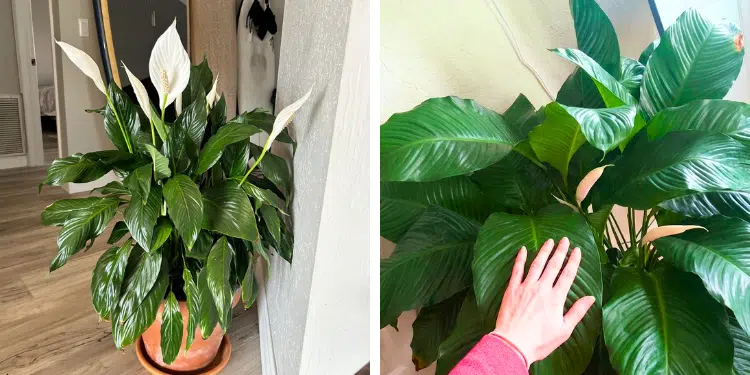
The Peace Lily (Spathiphyllum) is a cornerstone of the indoor botanical world, prized for its glossy, emerald foliage and its iconic white “flowers” (which are actually specialized leaf bracts called spathes).
While the Peace Lily is remarkably expressive – literally “fainting” when it needs water – it often settles into a state of stagnant growth during the winter months.
As we move through May, the internal biological clock of the Peace Lily accelerates. The increase in ambient light and the stabilization of indoor temperatures signal the plant to exit its conservation mode and enter its most aggressive growth phase.
If you want your Peace Lily to produce larger leaves and more frequent blooms throughout the summer, you must perform a “May Reset.”
This 5-minute routine aligns the plant’s environment with its tropical origins, providing the metabolic momentum needed for a high-performance season.
1. The “Hydration Flush” and Mineral Reset (2 Minutes)
Throughout the winter, tap water minerals and fertilizer salts can accumulate in the soil, leading to the dreaded “brown tips” on the leaves.
- The Mechanism: Peace Lilies are highly sensitive to fluoride and chlorine. In May, the plant’s transpiration rate increases, meaning it pulls water through its system faster. If the soil is “salty” from mineral buildup, this causes cellular stress at the leaf margins.
- The Action: Take your Peace Lily to the sink or shower. Water it thoroughly until the water runs freely from the drainage holes for at least 60 seconds. This “leaching” process flushes out accumulated salts and re-oxygenates the root zone.
- The Pro-Tip: Use filtered water or water that has sat out for 24 hours to allow chlorine to dissipate. This simple shift in May prevents the tip-burn that often plagues these plants in summer.
2. The “Solar Panel” Clean-Up (1 Minute)
Dust is the enemy of photosynthesis. Because the Peace Lily has broad, flat leaves, it acts as a magnet for household dust and pet dander.
- The Mechanism: Dust acts as a physical barrier, reflecting the light that the plant needs to create energy. A dusty Peace Lily is essentially “starving” even in a bright room.
- The Action: Use a soft, damp microfiber cloth to gently wipe both the top and underside of every leaf.
- The Benefit: By “opening” the stomata (pores) in May, you maximize the plant’s ability to process the increasing spring light. This is the single most effective way to trigger the production of new, white spathes.
3. Strategic “Deadheading” and Energy Redirection (1 Minute)
Many gardeners leave spent, browning blooms on the plant, but in May, this is a waste of precious biological resources.
- The Mechanism: Once a white spathe begins to turn green or brown, it is no longer contributing to the plant’s energy; it is consuming it. The plant will continue to send nutrients to that dying structure in an attempt to produce seeds.
- The Action: Follow the flower stem all the way down to the base of the plant and snip it off with sterilized shears.
- The Result: By removing “energy sinks,” you signal the rhizome to invest its nutrients into the development of brand-new foliage and future flower buds.
4. The “Light Gradient” Adjustment (30 Seconds)
In May, the sun sits higher in the sky and stays out longer. A spot that was “bright indirect light” in February might now be “burning direct light.”
- The Warning: Peace Lilies are “understory” plants; in the wild, they grow on the shaded forest floor. Direct May sunlight can scorch the leaves in just a few hours, leaving permanent brown scars.
- The Action: Move your plant roughly 2 to 3 feet further away from south or west-facing windows.
- The Goal: You want the plant to see the sky, but never the sun. This subtle move prevents heat stress and keeps the foliage that deep, rich green that characterizes a thriving specimen.
5. The “May Feeding” (30 Seconds)
Now that the plant is flushed and cleaned, it needs raw materials to build new tissue.
- The Action: Apply a balanced, liquid houseplant fertilizer (like a 10-10-10 NPK) at half-strength.
- The Frequency: Starting in May, begin a “low and slow” feeding schedule once every three to four weeks.
- The Caution: Never fertilize a dry Peace Lily, as this can burn the roots. Always perform your “Hydration Flush” first, then apply the diluted fertilizer to the damp soil.
Summary: Your May Peace Lily Checklist
| Step | Task | Biological Purpose |
| 1 | Flush Soil | Remove salt buildup and prevent brown tips. |
| 2 | Dust Leaves | Maximize photosynthesis for summer growth. |
| 3 | Deadhead | Stop energy waste on old blooms. |
| 4 | Shift Light | Prevent leaf scorch from stronger sun. |
| 5 | Fertilize | Provide fuel for new leaf production. |
The Peace Lily is a remarkably rewarding plant that responds quickly to environmental shifts.
By performing this 5-minute “May Reset,” you clear away the stagnation of winter and provide the plant with the oxygen, light, and nutrients it needs to thrive.