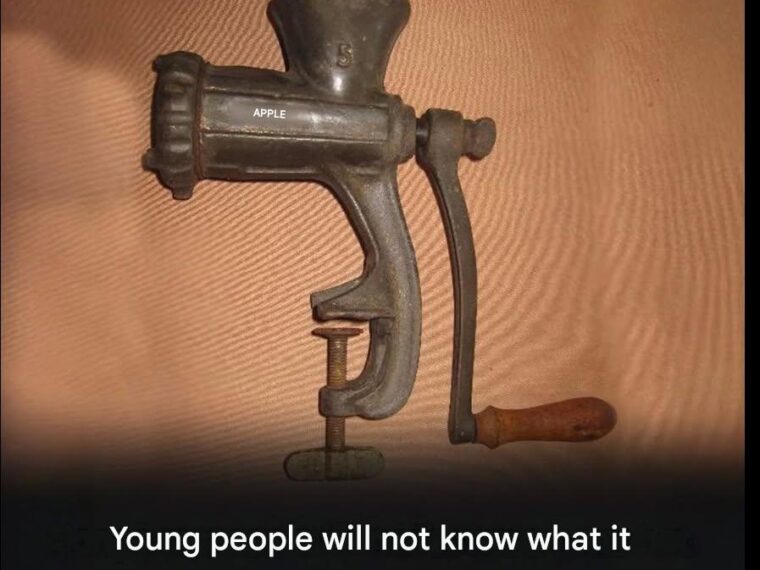
A strange metal device with a crank recently caused a stir on the internet. Some eventually recognized this mysterious object as a kitchen appliance that was once widespread – in our grandparents’ kitchens.
A strange, somewhat austere metal machine with a crank and a fascinating shape… That was all it took to unleash a wave of curiosity on social media. Thousands of internet users studied the photo and tried to guess what this object from another era was used for. A forgotten device? A mysterious tool? A workshop utensil? Speculation ran high. But the answer might very well be hidden quite simply… in our grandparents’ kitchen.
The mysterious object that fascinated internet users.
It all started with a simple photo posted online: a sturdy metal device with a crank and a round opening.
The reactions poured in quickly. Some thought it was an old mechanical tool, others suspected an agricultural implement or an industrial object.
However, some observant internet users immediately recognized this familiar object.
It was indeed a manual meat grinder, an appliance that used to be very common in family kitchens.
Before the widespread rise of robots and electric appliances, this small device was one of the most important tools for preparing many homemade dishes.
For an entire generation, its silhouette immediately evokes memories of meals prepared with patience and craftsmanship.
Operating the manual meat grinder is as simple as it is ingenious.
The device is typically attached to the edge of a table or worktop with a clamping screw. The meat is then inserted through the opening at the top.
By turning the crank, a worm gear drives the parts to a perforated plate at the end of the device.
The result: the meat comes out in the form of small, perfectly chopped strands.
This mechanical system made the preparation of many popular recipes easy: fillings, meatballs, hamburgers, or homemade dishes.
In a time when food was often prepared immediately at home, this device saved valuable time.
An invention whose origins lie in the 19th century.
The history of this device dates back to the 19th century, an era characterized by countless innovations in everyday objects.
One of the first models of a mechanical meat grinder is often attributed to the German inventor Karl Drais, who is known for his practical and ingenious inventions.
His idea was simple: to develop a mechanism that would process pieces of meat into minced meat quickly and easily.
Thanks to the crank and the internal screw, it was possible to achieve a consistent result with this device, while remaining fully manual.
This invention represented a small revolution in meal preparation at the time.
It made certain recipes more accessible and simplified work in the kitchen.
When culinary memories resurface
While some internet users discovered this object for the first time, others recognized the device immediately.
Many say they saw it in their grandparents’ kitchen, often in a drawer or hanging near the counter.
For her, the image evoked a true wave of nostalgia.
Some remember the distinctive sound of the turning crank, others the time they spent in the kitchen preparing the family meal.
These kinds of objects are reminiscent of a time when cooking was slower, but also more artisanal work.
Modern versions… but the old model resists.
Nowadays, electric meat grinders have largely replaced these manual models.
Ils permettent de préparer de grandes quantités de nourriture en quelques secondes et proposent souvent divers accessoires pour varier les possibilités de préparation.
Le hachoir à viande manuel n’a cependant pas complètement disparu.
Certaines personnes continuent de l’utiliser, attirées par sa simplicité, sa robustesse et son caractère authentique.
Parce qu’elle ne nécessite pas d’électricité, qu’elle est facile à nettoyer et qu’elle est pratiquement indestructible, elle reste un partenaire fiable pour les cuisiniers amateurs.
Et parfois, une vieille photo partagée sur Internet suffit à nous rappeler que les objets les plus simples peuvent receler de belles histoires du quotidien.