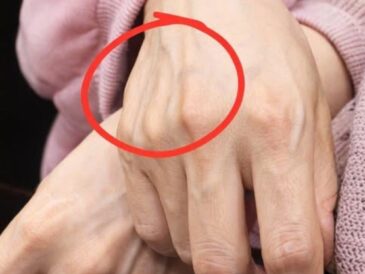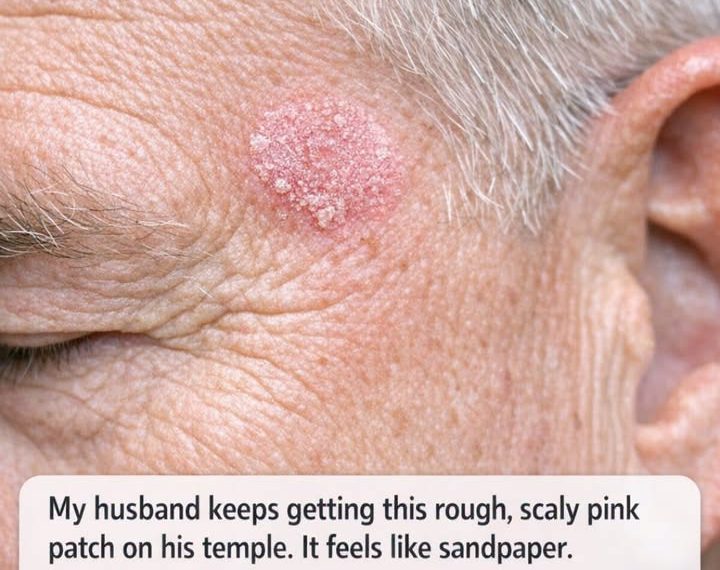
If your husband has a rough, scaly pink patch on his temple that feels a bit like fine sandpaper, one common cause is actinic keratosis, often shortened to AK. I’ve seen people describe it exactly that way: “I feel it before I really see it.” These spots often show up on sun-exposed skin like the temples, forehead, ears, scalp, cheeks, and backs of the hands, especially after years of cumulative sun exposure. Most are not a middle-of-the-night emergency, so if the clinic is closed today, that usually does not mean you are in immediate danger.
That said, AK matters because it is a warning sign of sun damage and, in some cases, can progress into a type of skin cancer called squamous cell carcinoma. In this article, I’ll walk you through what an actinic keratosis usually looks and feels like, what you can safely do today at home, the signs that mean he should be seen sooner rather than later, how doctors diagnose and treat it, and what to watch for over the next few days and weeks.
1. What actinic keratosis usually feels like
The “sandpaper” description is classic. An AK is often easier to feel than to see at first. If you run a fingertip over it, it may feel dry, rough, gritty, or prickly, almost like a patch of very fine emery board. The surface can be flat or slightly raised, usually from about 2 millimeters up to 1 or 2 centimeters across.
People sometimes notice that it catches a little when washing the face, shaving, or applying moisturizer. It may feel tender, sting a bit after face washing, or seem more obvious in cold, dry weather. Some patches come and go in how visible they look, while the roughness tends to linger.
2. What it tends to look like on the temple
On the temple, an AK often appears as a pink, red, tan, or skin-colored patch with fine scale. The edges may be a little indistinct rather than sharply outlined. In fair skin, it often looks pinker; in darker skin, it may appear more brown, gray, or subtly rough without much redness.
Some are flat and feel rough. Others are thicker and more obvious, with a flaky or crusty top layer. A few can look like a tiny horn or a very stuck-on dry spot. Because the temple gets a lot of sun over the years, it’s a common place for these lesions to show up, especially in adults over 40, and even more often after 50 or 60.
3. Why it happens
Actinic keratosis develops from cumulative ultraviolet damage, usually from years of sun exposure rather than a single afternoon outdoors. The skin cells in the top layer of the skin are altered by UV radiation, and over time that damaged area can become persistently rough and scaly.
Risk goes up with outdoor work, frequent driving, gardening, golfing, fishing, tennis, or any habit that puts the same areas in the sun repeatedly. Fair skin, light eyes, blond or red hair, a history of blistering sunburns, tanning bed use, immune suppression, and older age all increase the likelihood. I always tell people that AK is less about what happened last week and more about what the skin has “stored up” over 10, 20, or 30 years.
4. Is it serious if the clinic is closed today?
Usually, this is important but not an emergency. If the patch has been there for weeks or months and is simply rough, scaly, and mildly pink, it can generally wait for a routine appointment in the next 1 to 4 weeks. It does not usually require urgent care the same day if the only issue is roughness and mild irritation.
What makes it serious is not panic for today, but the fact that AK is considered a precancerous lesion. A small percentage can develop into squamous cell carcinoma over time. Estimates vary because studies look at different patient groups, but the practical takeaway is simple: it should be examined and, in most cases, treated, even if it is not a drop-everything emergency tonight.
5. What you can do safely at home today
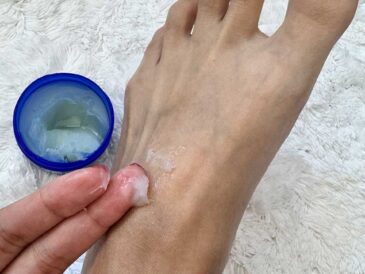
Keep the area clean and don’t scrub it. Wash gently with lukewarm water and a mild cleanser, then pat dry. A plain fragrance-free moisturizer or petrolatum can help with dryness and make the patch less irritated. If he shaves that area, it’s reasonable to avoid shaving directly over the spot until it is evaluated, especially if shaving keeps making it sore.
Sun protection starts immediately. If he goes outside, use a broad-spectrum sunscreen with SPF 30 or higher, ideally SPF 50 on the face, and reapply every 2 hours if outdoors. A brimmed hat with at least a 3-inch brim offers real mechanical protection. These steps won’t make an established AK disappear overnight, but they do reduce ongoing irritation and further UV damage.
6. What not to do while waiting
Don’t pick, scratch, or try to sand it off. That can cause bleeding, inflammation, or infection and can also make it harder for a clinician to judge what it really is. I would also avoid strong home acids, wart removers, retinoids borrowed from someone else, essential oils, or “natural” caustic treatments sold online. Temple skin is thin and easy to irritate.
Do not assume that because it flakes off, the problem is gone. AKs can seem to peel away and then recur in the same place. And don’t rely on over-the-counter hydrocortisone unless a clinician has suggested it for another reason; steroids may reduce redness temporarily without addressing the underlying lesion.
7. Signs that mean he should be seen sooner
There are several changes that move this from “book an appointment” to “please get this checked promptly.” Those include rapid growth over days to a few weeks, spontaneous bleeding, persistent tenderness, a firm thickened base, ulceration, or a crust that keeps returning. If the spot becomes noticeably raised or develops a hard, wart-like, or horn-like projection, that deserves earlier evaluation.
Also move faster if it is larger than about 1 centimeter, if there are multiple new spots appearing at once, if he is immunosuppressed, or if he has a personal history of skin cancer. On the face, especially near the temple, dermatologists tend to have a low threshold for examining lesions because facial skin cancers are easier to miss early and more important to treat precisely.
8. When it could be something other than actinic keratosis
Not every rough pink patch is an AK. Eczema can cause dry, itchy patches, though those often itch more and may improve clearly with moisturizers and time. Seborrheic dermatitis can create flaky pink patches around the scalp line, eyebrows, and sides of the nose. Psoriasis may make thicker, better-defined scaly plaques. A superficial fungal rash is less common on the temple but can happen.
Two lookalikes matter most: squamous cell carcinoma and basal cell carcinoma. Squamous cell carcinoma may start looking like a stubborn AK but tends to become thicker, more tender, or more ulcerated. Basal cell carcinoma often looks pearly or shiny, sometimes with tiny visible blood vessels, and may bleed easily. This is why a persistent facial lesion that lasts more than 4 to 8 weeks is worth a professional look even if it seems minor.
9. How doctors usually diagnose it
Many AKs are diagnosed clinically, meaning a primary care clinician or dermatologist can often identify them by appearance and texture during a skin exam. Dermatologists may use a dermatoscope, a handheld magnifying light, to inspect the surface pattern more closely. On a classic lesion in a classic location, that may be enough to decide on treatment.
If the spot is thick, inflamed, bleeding, unusually dark, rapidly changing, or simply not typical, a biopsy may be recommended. That usually means numbing the area with a small amount of local anesthetic and removing part or all of the lesion for lab review. On the temple, the procedure is usually brief, often taking 10 to 20 minutes in the office.
10. Common treatments and what they involve
The most common spot treatment is liquid nitrogen cryotherapy. The clinician freezes the lesion for a few seconds, sometimes with 1 or 2 freeze-thaw cycles. Afterward it may sting for 10 to 15 minutes, then redden, swell, and sometimes blister lightly before crusting and healing over 7 to 14 days on the face.
If there are multiple AKs or a broader “field” of sun damage, doctors may use field treatments instead of freezing just one spot. Options include 5-fluorouracil cream, imiquimod, diclofenac gel, or tirbanibulin ointment. Photodynamic therapy is another option, especially for facial lesions. These treatments intentionally make damaged areas inflamed before they heal, so patients should know in advance that redness and crusting can be part of the process for several days to several weeks depending on the medication.
11. What the risk of cancer actually means
This is the part that worries people, and understandably. Actinic keratosis is considered a precancerous lesion because some AKs can turn into squamous cell carcinoma. The exact chance for any single spot is hard to pin down and varies across studies, but the overall message from dermatology is consistent: the more AKs a person has, the greater the overall risk of future skin cancer.
I find it helpful to think of an AK as a marker of a sun-damaged skin environment. Even if one particular patch never becomes cancerous, its presence means the skin has had enough UV injury to produce abnormal cells. That is why treatment and long-term skin surveillance matter.
12. How soon to arrange follow-up
If the patch is stable, dry, and rough without bleeding or rapid change, a routine appointment within 1 to 4 weeks is reasonable. If getting dermatology takes longer, it is still worth booking the first available slot and asking to be placed on a cancellation list. A good clear smartphone photo taken in daylight from 6 to 12 inches away can help track changes while you wait.
If it starts bleeding, growing noticeably, becoming painful, or forming a persistent crust or sore, move that timeline up to urgent evaluation within a few days. If he has had skin cancer before, is on medications that suppress the immune system, or has had an organ transplant, I would treat “book it soon” more seriously and try for earlier assessment.
13. How to protect the skin from more spots
Daily sunscreen really does matter here. For the face, ears, scalp line, and temples, a broad-spectrum SPF 30 or 50 used every morning is a practical baseline. Most adults need about 1/4 teaspoon for the face alone, and roughly 1 ounce, or a shot-glass amount, for the whole body when fully exposed. Reapplication every 2 hours outdoors is the standard, and after sweating or toweling off, sooner.
Protective clothing helps more than most people expect. A wide-brimmed hat, UPF-rated clothing, and seeking shade between about 10 a.m. and 4 p.m. make a measurable difference. For someone who drives a lot, remember the temple on the window side often gets chronic UV exposure over years. Consistency matters more than perfection.
14. The bottom line for today
A rough, scaly pink patch on the temple that feels like sandpaper is very plausibly an actinic keratosis, especially if your husband has had years of sun exposure. If the clinic is closed today and the spot is not bleeding, rapidly enlarging, or very painful, this is usually not an emergency. Gentle skin care, moisturizer, and strict sun protection are sensible steps for now.
But it should not be ignored. Arrange a medical appointment, ideally within the next few weeks, and sooner if it changes. The key idea is calm attention: not panic tonight, not procrastination for months. That balance is exactly how most AKs are handled well.
RemedyDaily.com does not give medical advice, diagnosis, or treatment.