For years, I did what a lot of us do: I kept my honey in the refrigerator, scooped it into piping hot tea, and assumed that was the “healthy” way to use it. Once I started paying closer attention to how raw honey actually behaves in the kitchen—and to the specific ways it’s been used in studies for cough and throat comfort—I realized I’d been getting several basic things wrong.
If you’ve got a jar of raw honey in the pantry right now, these are the 16 rules I wish someone had handed me sooner. I’m not talking about trends or folklore here. I mean practical, everyday use: how much to take, when not to heat it, how to store it, what crystallizing really means, and where the real safety lines are.
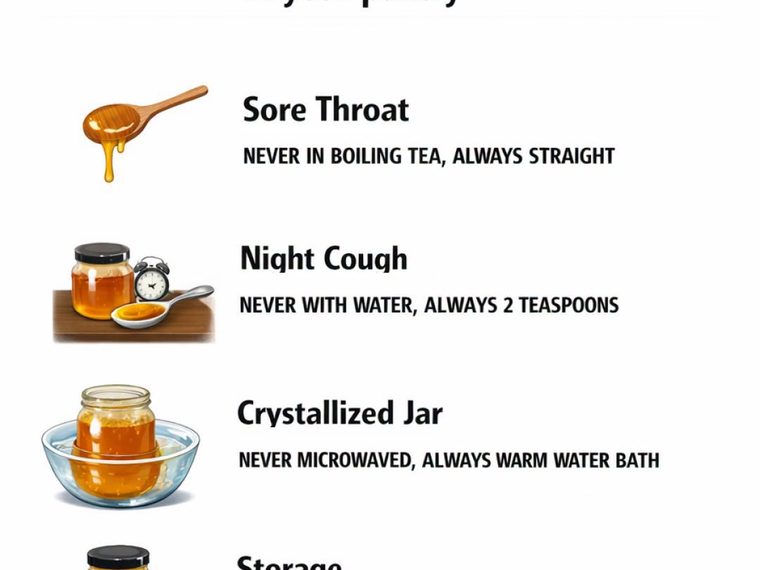
1. For a sore throat, never put raw honey in boiling tea—take a spoonful straight instead
This is the mistake I made for decades. If your goal is throat comfort, 1 teaspoon of raw honey taken straight does a better job coating the throat than honey diluted into a full mug of liquid. Once it’s stirred into 8 to 12 ounces of tea, that coating effect is reduced because the honey is dispersed instead of sitting directly on the irritated tissue.
There’s another reason to skip boiling tea: very hot liquid dulls raw honey’s delicate flavor and can reduce some of the enzymes people specifically buy raw honey for. The honest exception is warm tea, not hot tea. If your tea is warm enough to sip easily right away—not steaming and not freshly boiling—you can stir in 1 teaspoon then.
2. For a night cough, never mix it with water—take 2 teaspoons at bedtime
When people use honey for nighttime cough, the amount matters. The common study setup is honey taken straight before bed, not swirled into water and sipped over 20 minutes. If you want to use it the way it has actually been tested, measure 2 teaspoons and take it right before lying down.
That direct, bedtime spoonful lingers in the throat in a way a glass of water does not. I keep a teaspoon by the jar now for exactly this reason. It’s important to be clear, though: honey does not cure an illness. This is about temporary comfort, especially overnight.
3. If your honey crystallizes, never microwave it—use a warm water bath for 15 minutes
Crystallized raw honey is completely normal, but the microwave is the worst shortcut. Microwaves heat unevenly, so one part of the jar can get much hotter than another in seconds. That kind of overheating can thin the honey too fast, affect flavor, and make a sticky mess if the jar gets too warm near the rim.
Instead, set the closed jar in a bowl or pan of warm water for about 15 minutes. The water should feel hot from the tap but not boiling. If needed, refresh the water once and give it another 10 to 15 minutes. It’s gentle, reliable, and much easier on raw honey than a microwave burst.
4. Never store raw honey in the fridge—keep it on the counter with the lid closed
This one surprised me because I refrigerated mine for years. Honey keeps beautifully at room temperature, and the refrigerator actually encourages crystallizing. A pantry shelf or kitchen counter away from direct sun is ideal, generally around normal room temperature.
With the lid tightly closed, honey can keep for years. I like to store mine in a cupboard near the tea kettle but not right above the stove, where heat and steam are constant. Cold storage doesn’t make it safer; it just makes it grainier faster.
5. For dry lips, use a thin layer and leave it on for 10 minutes
A lot of people dab on honey and lick it off almost immediately, which defeats the point. For dry lips, spread on a very thin layer—about 1/8 teaspoon is plenty—and leave it in place for 10 minutes so it can sit on the skin instead of disappearing in 30 seconds.
After 10 minutes, wipe it away with a soft damp cloth or rinse gently with warm water. I do this before bed in winter when the heat is running indoors. It’s sticky, yes, but a thin layer is much easier to manage than a glossy blob.
6. Never throw out crystallized honey—it is not spoiled
Crystallizing is one of the most misunderstood things about honey. Those fine or chunky crystals do not mean the jar has gone bad. Raw honey naturally crystallizes over time, and some floral sources crystallize faster than others. In fact, raw honey often crystallizes sooner than highly processed honey.
If the aroma still smells like honey and the jar has been stored properly, crystals alone are not a reason to toss it. I’ve rescued more than one half-forgotten jar this way. Either use it crystallized on toast or loosen it with that warm water bath instead of wasting it.
7. Always use a dry spoon—water in the jar can lead to fermenting
This is a small habit that makes a real difference. If you dip a wet spoon into the jar—even a spoon with just a few drops of tea or sink water on it—you introduce moisture that honey doesn’t need. Over time, that extra water can raise the moisture level enough to encourage fermenting.
I now make a point of using a completely dry teaspoon every time, especially if I’m going back for a second spoonful. It sounds fussy, but it takes two seconds and helps protect a jar that may last months or longer.
8. Keep the lid tight because honey pulls moisture from the air
Honey is hygroscopic, which means it attracts moisture. If you leave the lid loose or off while you’re cooking, baking, or making tea, the honey can absorb water from humid kitchen air. That changes texture over time and can also make fermenting more likely.
So after every use, wipe the threads if needed and twist the lid on firmly. This matters even more in a steamy kitchen in summer or if you cook a lot on the stovetop. A tightly closed jar stays more stable in both flavor and texture.
9. Never give honey to babies under 1
This is the clearest safety rule on the list, and it needs to be plain: never give honey to babies under 1 year old. Not raw honey, not local honey, not a tiny taste on a spoon, and not mixed into food. Honey can contain spores that are harmless to older children and adults but dangerous to infants because of the risk of infant botulism.
There isn’t an exception here for “just a little.” If a baby is under 1, honey is off the table. This rule matters more than any storage tip or kitchen trick people pass around.
10. If you have diabetes, count honey as sugar—1 teaspoon has about 6 grams
Honey may sound more wholesome than table sugar, but your body still counts it as sugar. A practical number to remember is about 6 grams of sugar in 1 teaspoon. If you use 2 teaspoons at bedtime, that’s roughly 12 grams.
That doesn’t mean someone with diabetes can never have honey, but it does mean it should be counted honestly. I think this is where “natural” can mislead people. Natural does not mean free, and it does not mean it won’t affect blood sugar.
11. If you want raw honey, check the label—raw keeps its pollen and enzymes
Not every honey on the shelf is the same. Raw honey is generally less processed, which means it retains more of its natural pollen and enzymes. If that is why you are buying it, you need to read the jar, because a generic bottle labeled simply “honey” may be filtered and heated more heavily.
I tell friends to look for the word “raw” plainly on the front or ingredient panel and then buy from a source they trust. This isn’t about one jar being magical and another being worthless. It’s simply about matching the label to what you actually want in your pantry.
12. Never put pantry honey on open wounds
This is another hard safety line. The honey in your kitchen jar is food, not a sterile wound product. Medical-grade honey used in wound care is specially processed and sterilized for that purpose. The raw honey on your toast is not the same thing.
So if you have an open wound, skip the pantry honey entirely. This is one of those old-fashioned ideas that sounds harmless until you remember that food safety and wound care are not the same category. Use products meant for skin care or follow a clinician’s advice instead.
13. After a bedtime spoonful, brush or rinse your teeth
If you take 2 teaspoons of honey before bed and then go straight to sleep, that sugar sits on your teeth for hours. The practical fix is simple: brush your teeth after taking it, or at the very least rinse your mouth thoroughly with water.
I know that adds one more step when you’re tired, but it’s worth the 1 minute. A comforting bedtime habit should not quietly turn into a dental problem, especially if you use honey often during cold season.
14. Metal spoons are fine—the idea that they ruin honey is a myth
I grew up hearing that honey should only be touched with wood because metal somehow “reacts” with it and ruins it. In everyday kitchen use, that’s simply not true. A clean stainless steel teaspoon is perfectly fine for scooping and measuring honey.
What matters far more is whether the spoon is dry, not whether it is metal. I still use a wooden honey dipper sometimes because it’s pretty, but if I’m measuring 1 teaspoon or 2 teaspoons accurately, a regular metal spoon is the more practical tool.
15. For coughs, choose a dark honey like buckwheat
If you’re buying honey specifically to keep on hand for cough season, go darker rather than paler. Buckwheat honey is a good example. Dark honeys are generally richer in antioxidant compounds and have a stronger flavor, which is one reason they’re often preferred for this use.
That doesn’t mean clover honey is “bad.” It just means that if you’re standing in the aisle choosing one jar for the pantry, a dark honey is the more purposeful pick. Expect a deeper, maltier taste and a darker brown color than the light golden honeys many of us grew up with.
16. If a cough lasts more than 3 weeks, see a doctor
Honey has its place, but it also has limits. If a cough hangs on for more than 3 weeks, that’s the point where home comfort measures are no longer enough on their own. A lingering cough can have several causes, and it deserves proper medical attention.
This is especially true if the cough keeps returning, disrupts sleep night after night, or comes with other concerning symptoms. A pantry remedy is for short-term comfort, not for postponing care you really need.
Raw honey is simple, but using it well is more specific than most of us were taught. Once I stopped refrigerating it, stopped blasting it with heat, and started measuring it with a dry teaspoon instead of guessing, that humble jar became much more useful—and much less mysterious.