Meet your plants’ greatest winter nemesis: you. When the sun checks out, your houseplants drop their growth routine like a bad habit. The resulting low light and cool air mean the soil stays wet longer than your favorite uncle’s vacation story.
So how do you ensure your plants actually make it to spring? Divide your green family into watering schedules based on just two simple facts: Who hates water, and who merely tolerates it.
Monthly Hydration (Or Less, If You Dare)

These guys are hardy like Tom Hardy while not being hydro-friendly. Count on them if you are looking to cut down on water expenses and enjoy looking at buffed… greens.
If your home goes full dungeon-mode in winter, these houseplants that grow without sunlight can help fill in the dark corners without complaint.
1: Snake Plant

This indoor plant’s goal in winter is to remind you how little it needs you. They slow down massively when the sun abandons us and consume next to no water.
If you water the Snake Plant more than once every six to eight weeks, you are signing it up for an early retirement.
If your Snake Plant ever starts curling, here’s how to diagnose and straighten those leaves before it gets worse!
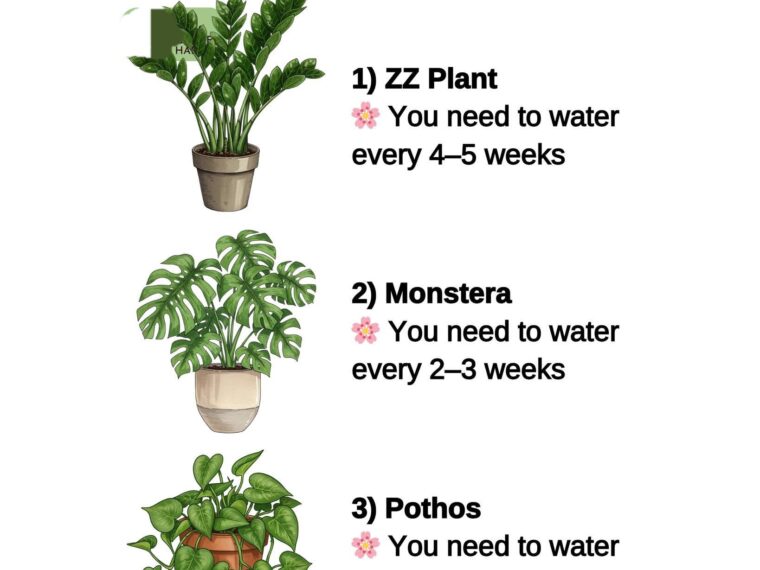
2: ZZ Plant

If you thought the Snake Plant was lazy, wait ‘till you meet the ZZ. It’s a hibernation master, extremely drought-tolerant and equipped with potato-like water-storing rhizomes.
It’s sufficient to check in on it with the watering can every four to five weeks.
Quick tip: When I’m unsure whether my ZZ needs water, I gently squeeze the base of a leaf stalk. If it still feels firm, those fat little rhizomes are doing their job and I walk away like a responsible adult.
And if you really want a challenge, here’s how to make a ZZ Plant actually flower indoors, yes, it can happen!
3: Aloe Vera

Its thick succulent leaves are built-in water tanks so when winter hits, they’re fully stocked, thank you very much! Aloe requires almost zero attention, thus a watering cadence of every four to six weeks is perfectly fine. Just leave it alone. It won’t guilt trip you.
Quick tip: Aloe tells you it’s thirsty by getting slightly thinner or a bit soft in the middle section of the leaf. Not mushy, just a tiny hint of deflation. It’s like a cactus texting “u up?” once every six weeks.
4: Jade Plant

Another member of the thick-leaf club. Jade Plants handle long gaps between hydration with grace because they are already holding onto their moisture stash.
Checking in on them every three to five weeks is plenty enough. If you notice any shriveling, then you can water; otherwise, assume they are still working through last month’s supply.
Winter is also a great time to refresh or restart some plants entirely, these are the houseplants you can propagate from cuttings in December, even when everything seems to be asleep.
5: Monstera

You’d think this tropical giant drinks like a sailor. But even the mighty Monstera deliciosa hits the brakes hard in winter. Wait for the top couple of inches to feel dry like your mouth in the morning before you even consider hydration.
That usually buys you a gap of two to three weeks. Got a massive pot? Great! You might get a free pass, stretching that delay toward a full month.
If your Monstera ever starts curling its leaves when winter rolls in, here’s exactly how to revive a curling Monstera before things go downhill.
6: Rubber Plant

Ficus species significantly reduce their growth in cold weather. They’ll still absorb moisture, true, but at a glacial pace. It’s ok if you water them only every two to three weeks.
And even then, it’s only to avoid suffocation. They’re not asking for a lot, but they will complain (via dropping leaves) if you confuse slow-growing with slow-drying.
Quick tip: Rubber Plants don’t show thirst until a bit late, so I lift the pot instead. The soil feels heavy for so long in winter that a light pot means it’s time to water, no guessing needed.
7: Fiddle Leaf Fig

Consistent with the tropical winter slowdown indoors, the Fiddle Leaf Fig is happiest if you water it every two to three weeks. They are already dramatic enough on their own.
Low light in your home can easily push this schedule toward a cautious four weeks.
Weekly Check-Ins (Because They Still Need Your Validation)

Brace yourself, you actually have to pay attention to these few. They cannot handle long stretches of dryness, just like a Brit in Greece.
1: Peace Lily

2: Pothos

These popular trailing vines know how to slow down, but they refuse to commit to the desert lifestyle. While they do dry more slowly, they still require semi-regular moisture.
Wait until the top couple of inches are dry to the touch, which typically puts you in the ten to fourteen-day window. They’re kind enough to tolerate slight forgetfulness, but do not push your luck.
And if your Pothos is rooting like a champ but refusing to grow leaves, this guide breaks down why healthy roots don’t always mean healthy growth and what to adjust.
3: Spider Plant

Plan on watering the Spider Plant every ten to fourteen days. Its chunky roots are designed to store water (hence the frequency), but it is not built for the extreme, month-long drought of the Snake Plant. It is a precise and low-key schedule that ensures the puppies stay happy, too.
Quick tip: Spider Plants show thirst by getting tiny brown tips and a bit of leaf curl. If the baby spiders start looking limp, it’s been too long. They bounce back, but they’ll gossip about you for days.
If yours ever dips into the yellow-and-droopy phase, here’s how to fix Spider Plant troubles and bring it back to life.
4: Philodendron (Heartleaf, Brasil, and others)

As natural climbers, they’re accustomed to steady, jungle-floor kind of hydration. They slow down, but they’re not built for flaky desiccation. So if you stretch the water gaps too far, it will tell you off with yellow and brown leaf edges.
Stick to a check-in every ten to fourteen days to prove you’re the less impulsive life form in the room.
Quick tip: Heartleafs whisper for water by yellowing their lowest leaves first. If the edges get crispy, you’ve definitely pushed your luck. Lesson learned (again).
If you’re experimenting with gentle winter boosters, you might enjoy this guide on plants that thrive on rice water, and how to use it safely.
5: Moth Orchids

The most unique drinkers on the list. You do not water these on a schedule. You water them when they tell you to. Phalaenopsis types only need a drink when their roots (visible in a clear pot) turn a silvery-gray color.
For most, this lands around the ten to fourteen-day mark. Just whatever you do, never leave the moss or bark sitting in swampy water. They’re orchids, not orc kids.
If you love low-effort plants, you might also enjoy this list of houseplants that grow faster in water than in soil, perfect for winter when soil dries unpredictably.
When in Doubt, Walk Away
Here’s how to survive the winter watering minefield. It’s always simpler to revive a droopy plant than to save one from terminal root rot. The golden rule is restraint. Your indoor plants will surely appreciate it come spring, provided they’re not dead by then.
If you’re updating your winter care routine anyway, here’s a full guide on houseplants you actually can fertilize during winter, and the ones you definitely shouldn’t touch.
And one last winter trick I swear by: I always check the weight of the pot first. Dry soil becomes shockingly light, and it’s the easiest way to tell if a plant actually needs water,especially when the surface looks dry but the middle is still swampy.
But, if the pot is big (like with a Monstera or Snake Plant), I fall back on the oldest trick in the book: the thumb test. I just stick my finger a couple of inches into the soil, if it feels dry that far down, then it’s finally time for a drink. If not? I walk away.