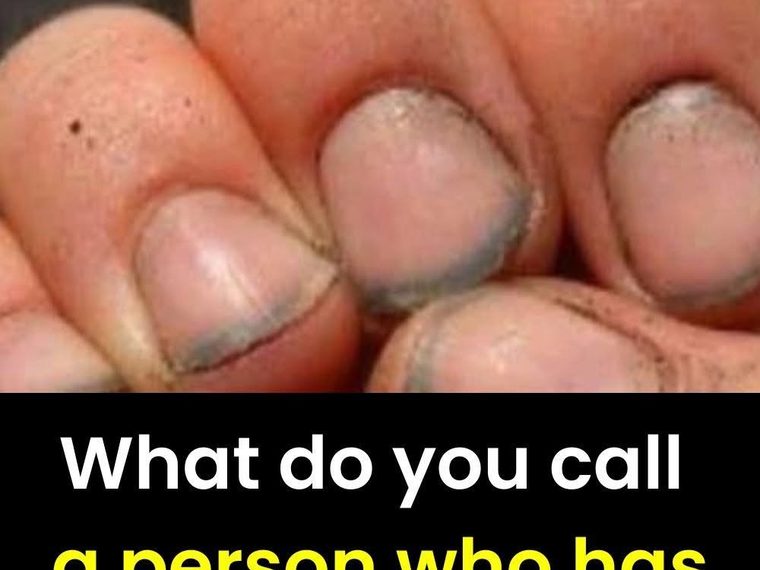
Your Fingernails May Be Revealing Something About Your Health! What Does This Unusual Shape Mean? 💅⚠️
Have you ever noticed someone whose fingertips look unusually rounded or swollen, with nails that curve downward over the ends of their fingers?
At first glance, it may seem like an ordinary difference in nail shape. But sometimes, this appearance can be associated with a medical condition known as nail clubbing.
Doctors have studied this unusual change for many years because it can sometimes provide important clues about a person’s health, particularly their lungs and heart.
But what exactly is nail clubbing? Why does it happen, and when should someone be concerned?
Let’s take a closer look.
1. What Is Nail Clubbing?
Nail clubbing is a physical change that affects the shape of the fingertips and nails.
Instead of having a relatively flat nail bed and a normal fingertip shape, the ends of the fingers may become enlarged and rounded.
Common characteristics include:
- Fingertips that look wider or more bulbous.
- Nails that curve downward around the fingertips.
- A softer or spongier feeling around the nail bed.
- A more rounded appearance when viewed from the side.
- Changes that gradually affect several fingers.
Clubbing can develop over time and may affect both fingernails and toenails.
It is not simply a matter of having naturally curved or long nails. The shape of the fingertip itself also changes. <Cite refs={[“turn302150search0″,”turn302150search7”]}/>
2. Why Does Nail Clubbing Happen?
Nail clubbing occurs when the soft tissue beneath and around the nail becomes enlarged.
The exact biological mechanisms are complex, but changes involving blood flow, tissue growth, and signaling molecules are thought to play a role.
Importantly, clubbing can sometimes be associated with conditions affecting the heart, lungs, digestive system, or liver.
This is why doctors take newly developed nail clubbing seriously rather than treating it as a cosmetic issue. <Cite refs={[“turn302150search8″,”turn302150search11”]}/>
3. Lung Conditions Can Be One Possible Cause
One of the most important associations doctors investigate is lung disease.
Nail clubbing may occur in people with certain respiratory conditions, including:
- Lung cancer.
- Bronchiectasis.
- Cystic fibrosis.
- Interstitial lung disease.
- Certain long-term lung infections.
However, having clubbed nails does not automatically mean someone has lung cancer.
There are several possible explanations, and only a medical evaluation can help identify the underlying cause. <Cite refs={[“turn302150search0″,”turn302150search7”]}/>
4. Can Heart Problems Also Cause This Nail Shape?
Yes. Certain heart conditions can be associated with clubbing.
These include some congenital heart conditions and infective endocarditis, an infection affecting the inner lining of the heart or its valves.
When doctors notice unexplained clubbing, they may ask about symptoms such as breathlessness, persistent cough, fever, or unusual tiredness.
The purpose is to investigate the cause rather than assume that the nail appearance points to one specific disease. <Cite refs={[“turn302150search7″,”turn302150search8”]}/>
5. Other Health Conditions That May Be Associated With Clubbing
Although lung and heart conditions are important causes, they are not the only possibilities.
Nail clubbing has also been associated with:
- Certain liver diseases.
- Crohn’s disease.
- Celiac disease.
- Some thyroid conditions.
- Certain gastrointestinal disorders.
- A hereditary tendency in some families.
In some people, clubbing can be inherited and may occur without an underlying disease.
This is another reason why a proper medical assessment is important. <Cite refs={[“turn302150search0″,”turn302150search8”]}/>
6. How Can You Recognize Possible Nail Clubbing?
Doctors look at more than just the front of the nail.
One useful examination is called the Schamroth window test.
To perform this simple observation:
- Place the backs of your index fingers together.
- Bring the nails toward each other.
- Look at the small diamond-shaped gap that normally appears between the nail beds.
If this gap is absent, it may suggest clubbing.
However, this test is not a diagnosis. A healthcare professional needs to examine the fingers and consider the person’s medical history. <Cite refs={[“turn302150search0″,”turn302150search8”]}/>
7. What Should You Do If Your Fingernails Look Like This?
If you notice that your fingertips are becoming increasingly rounded or your nails are developing an unusual downward curve, arrange an appointment with a healthcare professional.
A doctor may:
- Examine your nails and fingertips.
- Ask when the changes first appeared.
- Review your medical and family history.
- Listen to your heart and lungs.
- Recommend blood tests, imaging, or other investigations if necessary.
If clubbing is caused by an underlying medical condition, treating that condition may sometimes improve the appearance of the nails.
Seek urgent medical help if nail discoloration occurs suddenly together with blue lips, severe breathlessness, chest pain, or confusion. <Cite refs={[“turn302150search0″,”turn302150search2″,”turn302150search7”]}/>
8. Is Nail Clubbing Treatable?
There is no single treatment that directly corrects every case of clubbing.
The appropriate treatment depends on its cause.
For example, if it is associated with an underlying lung, heart, digestive, or thyroid condition, doctors focus on treating that condition.
In some cases, the nails and fingertips may gradually return toward their normal appearance after the underlying problem is treated.
However, improvement is not guaranteed in every situation. <Cite refs={[“turn302150search0″,”turn302150search11”]}/>
Conclusion: Never Ignore a New or Unusual Change in Your Nails!
Your fingernails can sometimes provide useful clues about what is happening inside your body.
An unusual rounded fingertip shape and downward-curving nails may indicate nail clubbing, a condition that can be associated with several underlying health problems.
It does not automatically mean something serious is wrong, but newly developed clubbing should always be checked by a healthcare professional.
Remember: your nails are not just part of your appearance. Sometimes, changes in their shape can be an important reason to pay attention to your health! ❤️


