Every home gardener who has ever grown cucumbers (Cucumis sativus) knows both the immense reward and the sudden frustrations that come with this fast-growing, heavy-feeding vine.
One week you are looking at a lush canopy of emerald leaves and bright yellow flowers; the next, you are battling pale foliage, aborted fruit, or the dreaded white powdery coating of fungal disease.
Because cucumbers grow rapidly and produce heavy, water-dense fruits over a short period, their metabolic demand for easily accessible nutrients is exceptionally high.
While commercial synthetic fertilizers can provide a quick shot of nitrogen, phosphorus, and potassium (N-P-K), they often fail to support the complex soil biology that cucumbers rely on for long-term health.
Over-fertilizing with synthetic nitrogen can also lead to lush leaves at the expense of blossoms, or make the plant more appealing to pests like aphids.
Fortunately, you can unlock optimal growth, maximize fruit yield, and build strong natural disease resistance using a highly effective, low-cost botanical solution right from your kitchen: a natural milk and yeast fertilizer.
This traditional organic gardening method blends the calcium and proteins found in milk with the living, enzymatic power of active yeast.
Together, they create a highly effective biostimulant that feeds both the cucumber plant and the beneficial microorganisms in the surrounding soil.
The Science: Why Milk and Yeast Work Together
To understand why this combination works so well for cucumbers, we can look at the specific nutritional and biological properties that milk and yeast independently bring to your garden beds.
The Role of Milk: Cellular Strength and Fungal Defense
Cucumbers are highly prone to localized calcium deficiencies. When a cucumber plant cannot transport enough calcium to its developing tissues, it experiences structural cell-wall failure.
This shows up as distorted leaf growth, dying vine tips, and “blossom-end rot” – a condition where the blossom end of the fruit turns yellow, soft, and black before it can fully mature.
The bioavailable calcium in milk reinforces cell walls, ensuring straight, crisp, and hollow-free cucumbers.
Furthermore, milk contains a natural iron-binding protein called lactoferrin, along with specific whey proteins.
When sprayed directly onto leaves as a foliar mist in bright sunlight, these proteins interact with solar radiation to produce a mild, natural antiseptic environment.
This safely inhibits the germination of fungal spores, making milk one of nature’s most effective preventative shields against powdery mildew, which frequently attacks cucumber patches in humid summer weather.
The Role of Yeast: Microbial Activators and Root Expansion
Active baker’s yeast (Saccharomyces cerevisiae) is a single-celled living fungus rich in B-complex vitamins, proteins, amino acids, and vital trace minerals.
When introduced to the soil, yeast doesn’t just feed the plant directly; it acts as a powerful microbial activator.
As the yeast cells interact with organic matter in the soil, they accelerate the decomposition process, releasing carbon dioxide and converting locked-up minerals into highly bioavailable forms that the cucumber’s root system can readily absorb.
This biological activity stimulates rapid root branching, increasing the plant’s overall surface area for absorbing water and nutrients.
Step-by-Step Recipe and Fermentation Protocol
To get the most out of this natural solution, you must follow a careful preparation process. Allowing the yeast to activate fully before combining it with the milk ensures maximum enzymatic potency without creating unpleasant odors in your garden.
Raw Ingredients Matrix
- Active Dry Yeast: 1 packet (7 grams or approximately 1 tablespoon)
- Granulated White Sugar: 2 tablespoons (Serves as the essential food source to activate the yeast)
- Lukewarm Water: 1 quart (Approximately 100°F to 105°F; avoid chlorinated tap water if possible)
- Milk: 1 cup (Whole milk, skim milk, buttermilk, or even sour milk work exceptionally well)
- Filtered Water (for final dilution): 2.5 gallons
1. Activate the living yeast culture
Pour one quart of lukewarm water into a large bucket. Stir in the two tablespoons of granulated sugar until fully dissolved.
Sprinkle the packet of active dry yeast over the water’s surface, whisking gently. Let the mixture sit undisturbed for 2 to 3 hours in a warm room.
You will know it is ready when a thick, frothy, and highly aromatic layer of foam forms across the surface, signaling active fermentation.
2. Introduce the dairy component
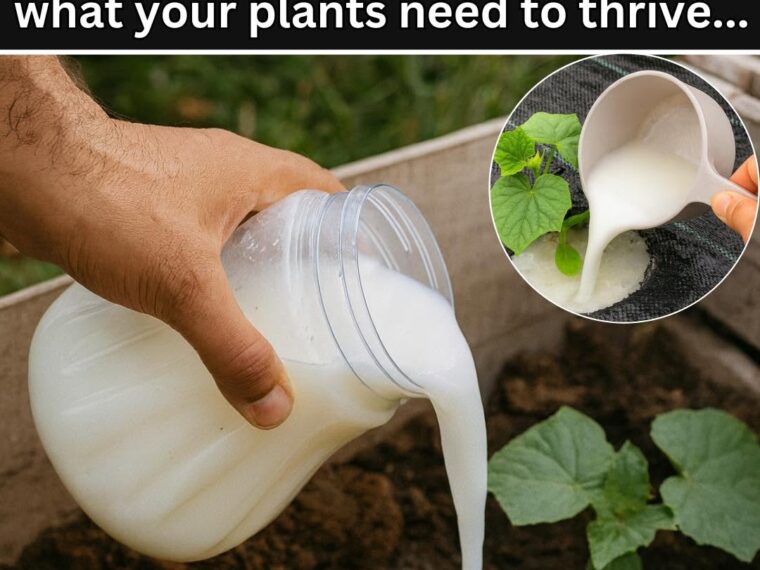
Once the yeast mixture is frothy, pour in the one cup of milk. Whisk the solution thoroughly for thirty seconds until the milk proteins and living yeast cultures form a uniform, pale emulsion.
3. Execute the final water dilution
Pour the concentrated milk and yeast emulsion into a large watering can or clean bucket containing 2.5 gallons of room-temperature, dechlorinated water. Whisk the solution thoroughly.
Never apply the concentrated mixture directly to your plants, as undiluted milk can sour in the heat, blocking soil pores and attracting unwanted pests.
Application Methods for Maximum Yield
This versatile solution can be applied using two distinct methods to address different aspects of your cucumber plants’ metabolic development.
Method A: Deep Root Drenching (Soil Feeding)
The Technique: Pour the diluted mixture directly onto the soil at the base of your cucumber plants, saturating the root zone out to the vine’s drip line.
Apply approximately 2 to 3 cups of liquid per mature plant. Ensure the soil is already slightly damp before application to prevent the liquid from draining away too quickly.
Frequency: Repeat this root drench once every 14 days from early summer through the peak harvesting window. This provides a steady supply of calcium and maintains a highly active microbial community around the root zone.
Method B: Protective Foliar Spraying (Mildew Prevention)
The Technique: Strain the fully diluted mixture through a fine cheesecloth to remove any tiny sediment that could clog a nozzle, then pour it into a clean garden pressure sprayer.
Spray the cucumber vines thoroughly, making sure to coat both the tops and the undersides of the leaves until they are dripping.
Frequency: Apply this foliar mist once every 7 to 10 days, ideally in the early morning on a bright, sunny day. The sunlight activates the milk proteins, creating a natural protective shield that stops fungal spores from taking root on the leaf surfaces.
4 Pro-Tips for Managing an Abundant Cucumber Patch
To maximize the benefits of your milk and yeast biostimulant, combine your feeding schedule with these core cucumber management principles:
1. Maintain Unwavering Moisture Consistency
Cucumbers are composed of roughly 95% water. If the soil undergoes extreme wet-to-dry cycles, the fruits will quickly develop a bitter taste due to the accumulation of defense compounds called cucurbitacins.
Keep the soil consistently moist – like a wrung-out sponge – by applying a thick, 3-inch layer of organic mulch (such as straw or shredded leaves) around the base of the vines to lock in moisture.
2. Prioritize Vertical Trellising
Cucumbers are natural climbers. Allowing the vines to scramble across open, damp soil invites ground-dwelling pests and leaves the foliage highly vulnerable to soil-borne fungal diseases.
Elevating your cucumber patch on a vertical A-frame trellis or cattle panel fence keeps the fruits clean and perfectly straight.
It also significantly improves airflow through the canopy, allowing your foliar sprays to dry quickly and reducing disease pressure.
3. Ensure Strategic Companion Planting
Cucumbers thrive when surrounded by beneficial plant partners. Plant rows of vibrant zinnias and marigolds nearby to draw in crucial pollinators like bumblebees, ensuring high fruit pollination rates.
Additionally, interplanting with aromatic herbs like basil or dill helps confuse flying insect pests, naturally protecting your developing vines.
4. Harvest Frequently and Consistently
A cucumber vine’s primary biological goal is to produce mature seeds. If you leave oversized, yellowing cucumbers to ripen fully on the vine, the plant will signal its metabolic system to stop producing new blossoms.
Harvest your cucumbers daily when they are firm, bright green, and at their peak size for their specific variety. This frequent picking keeps the vine in a continuous fruiting cycle all summer long.
Cultivating an abundant, disease-free cucumber patch doesn’t require complex or expensive synthetic inputs.
By utilizing the simple, time-tested combination of milk and yeast, you work in harmony with your garden’s natural biological processes.